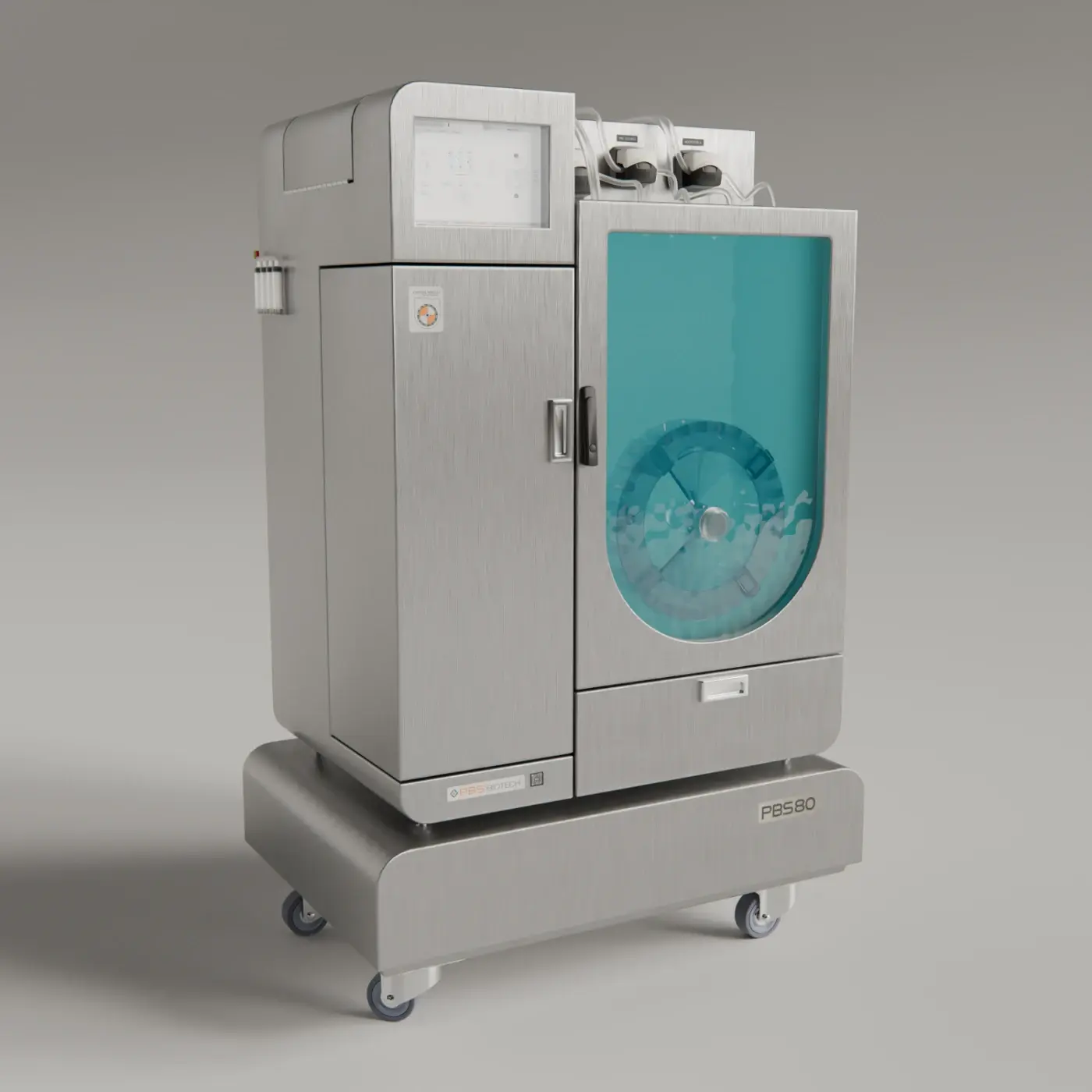
PBS-80
The commercial-scale manufacturing bioreactor for allogeneic cell therapy production at scale. built on the same Vertical-Wheel® Technology validated at every previous scale.

Why PBS-80
The PBS-80 extends proven processes to commercial production volumes while preserving the culture environment your cells have been thriving in. It is designed to help manufacturers increase output, support growing demand, and maintain process consistency across the product lifecycle.
Manufacture large cell therapy batches at production-relevant volumes.
Standardize large-scale manufacturing with recipes, process control, alarms, and comprehensive data capture.
Designed for commercial manufacturing with single-use, cGMP-ready vessels and secure, audit-ready, 21 CFR Part 11-compliant software and IQ/OQ documentation.
Support high-density, high-yield production using external perfusion systems and closed-system manufacturing workflows.
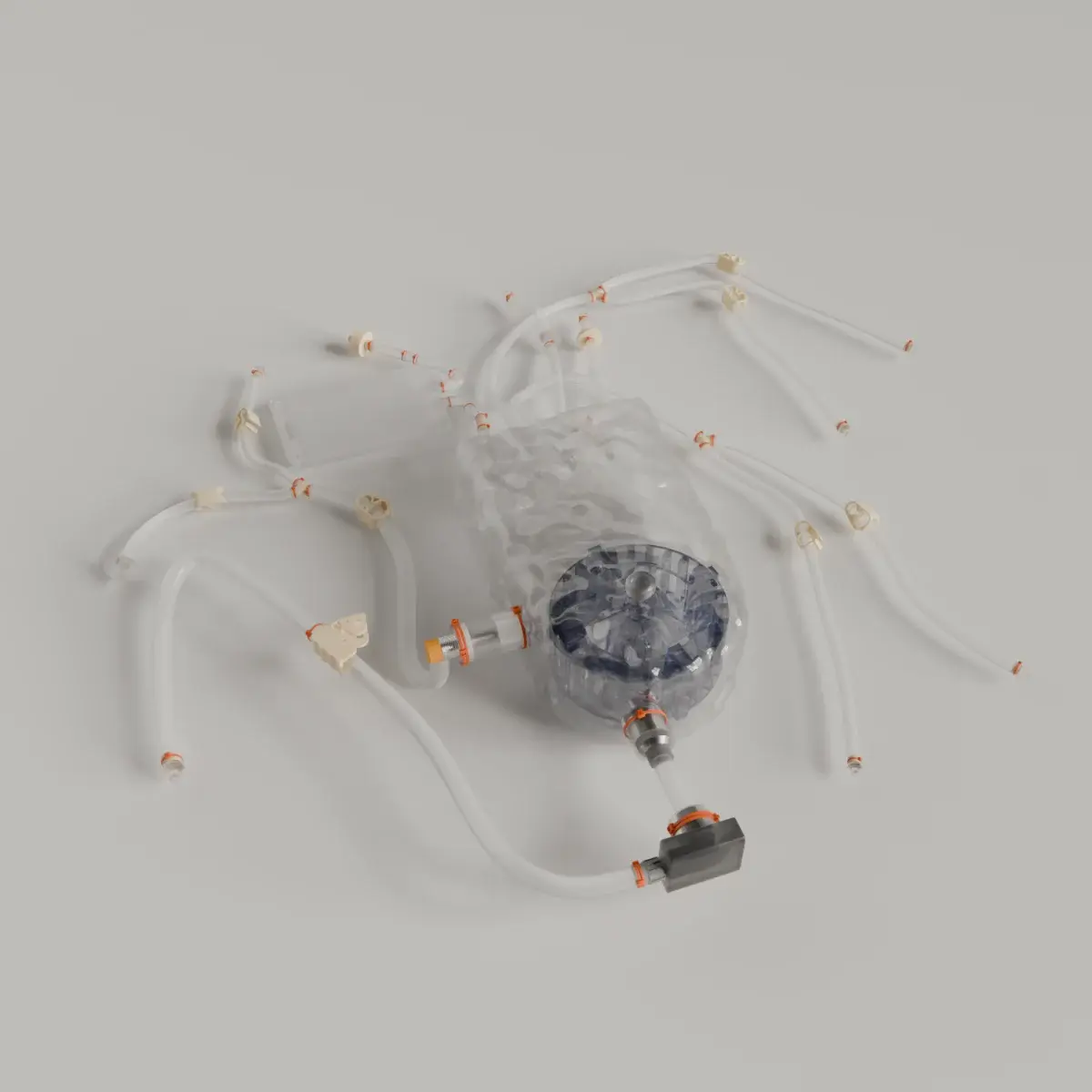
The PBS-80 Vertical-Wheel FLUIDIX™ Vessel
The PBS-80 runs pre-sterilized, single-use Vertical-Wheel FLUIDIX™ 80L Vessels for commercial-scale manufacturing to meet the market demand of your therapy.

Proven With PBS-80
Published Vertical-Wheel data at this scale — protocols, app. notes, peer-reviewed papers, case studies, posters, webinars, etc.
The PBS Closed-System Sampling Conical supports aseptic, representative sample collection from PBS Vertical-Wheel® Bioreactors while maintaining process integrity and sample quality. The single-use assembly combines a gamma-irradiated vented conical, integrated dip tube, and weldable tubing to reduce contamination risk, handling steps, and operator variability. Compatible with stem cells, immune cells, organoids, and aggregate cultures, it supports routine in-process analyses including cell counts, viability testing, metabolite monitoring, and aggregate characterization.
This application note describes an hMSC manufacturing workflow using RoosterBio cell products, xeno-free media, and PBS Biotech Vertical-Wheel bioreactors. Studies evaluated microcarrier culture, fed-batch operation, harvest, scale-up, and cell quality. The low-shear, uniformly mixed environment supported robust attachment and cell densities up to 500,000 cells/mL within five days. Fed-batch processing improved media productivity by eliminating routine media exchanges and reducing labor. Comparable growth and metabolite control were maintained across development, pilot, and production…
This publication combines oxygen-transfer rate measurements through surface aeration for Vertical-Wheel bioreactors with specific oxygen-uptake measurements from human induced pluripotent stem cell aggregate cultures. Oxygen mass-transfer coefficients (kLa) were measured under different agitation rates, working volumes and headspace gas-flow conditions in 3, 15 and 80 L systems. The specific oxygen-uptake rate of iPSC aggregates was measured in a 0.1 L bioreactor using a custom dissolved oxygen probe configuration. These datasets were combined to estimate the theoretical maximum cell…
This publication examines upstream process challenges associated with scale-up of pluripotent stem cell cultures for commercial allogeneic cell therapy manufacturing. Key variables include seed train generation, hydrodynamics, aggregate morphology, oxygen transfer, carbon dioxide removal, medium exchange, and harvest. Computational fluid dynamics and experimental studies demonstrate the use of energy dissipation rate as a scale-up parameter for maintaining consistent aggregate morphology. The authors also present oxygenation and scalable medium exchange strategies to address process…
This case study evaluates an integrated workflow for expansion, dissociation, harvest, concentration, and serial passage of human induced pluripotent stem cells using Vertical-Wheel® Bioreactors and single-use tubular-bowl centrifugation. Closed processing achieved 89.9% cell recovery compared with 93.3% for open benchtop centrifugation, with similar post-processing growth. Serial expansion at 3 L consistently achieved greater than 90% recovery and greater than 95% post-harvest viability while maintaining spherical aggregates, stable expansion, and OCT4 and SOX2 expression. Process modeling…
This book chapter examines scale-up of anchorage-dependent cell cultures from planar systems to commercial bioreactor manufacturing. It reviews hydrodynamics, microcarrier suspension, shear sensitivity, and bioreactor design requirements for cell therapy production. Vertical-Wheel® Technology is presented as a scalable, single-use platform providing uniform mixing, efficient particle suspension, and low-shear conditions across multiple scales. Studies with mesenchymal stem cells and other adherent cultures demonstrate cell growth and process scalability. The chapter provides engineering and…
PBS-80 Parts - (selected parts are added to cart for quote requests)
Loading part numbers…
We Support You Every Step of the Way
Our application scientists help you get the most out of PBS-80, and help you plan for the steps that come next.
Our application scientists optimize cell yield and quality on PBS-80 with you.
Equivalent set points from PBS-80 to commercial scale, CFD-validated at every step.
Guided-optimization packages that move you from R&D to clinical scale.
Go Vertical, Today
Tell us what you need and we’ll take it from there.